
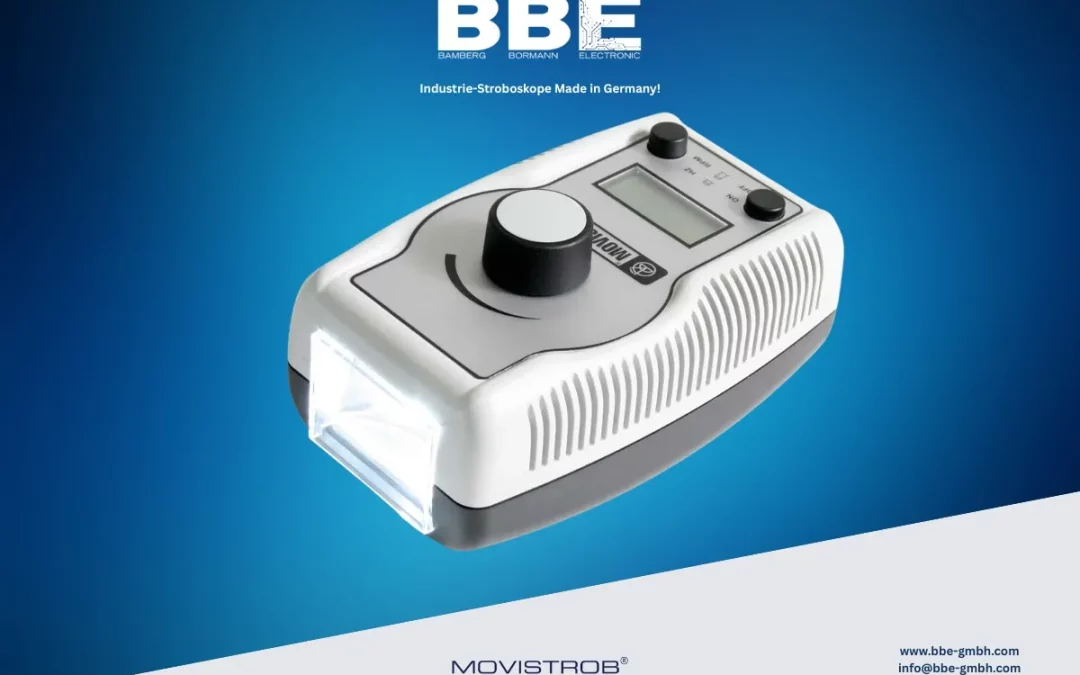
Making Invisible Motion Visible: What Is an Industrial Stroboscope?
Introduction: Making Invisible Motion Visible
Modern industry is driven by precision, speed, and quality. Production systems often operate at extremely high cycle rates, drives rotate within fractions of a second, and even minor defects can lead to costly downtime. This is where industrial stroboscopes come into play. Using specialized technology, they make fast motion sequences visible, enable precise rotational speed measurement, and reveal defects that are impossible to detect with the naked eye.
But what exactly is an industrial stroboscope, how does it work, and how does it differ from simple stroboscopes commonly known from event lighting or physics lessons?
Basic Principle: Light Pulses as a Measuring Instrument
The term stroboscope originates from the Greek words strobos (whirl, rotation) and skopein (to look)—literally meaning “to observe rotation.” This perfectly describes the function of a stroboscope: a rotating or vibrating object is illuminated by rapid, periodic light flashes. When these flashes occur at exactly the right frequency, the object appears stationary to the human eye.
This optical illusion makes motion visible and measurable. The principle is similar to effects sometimes observed with old film projectors or fluorescent lighting, where a rotating fan may appear motionless or even rotating backward. The key difference with an industrial stroboscope is that this effect is generated deliberately, precisely, and in a controlled manner to perform accurate measurements.
How It Works in Detail
An industrial stroboscope essentially consists of three main components:
Light Source
In the past, xenon flash lamps were commonly used. Today, high-power LEDs are the standard, providing uniform, intense illumination with extremely short exposure times.
Control Electronics
The control unit determines the flash frequency—how many flashes are emitted per second. This frequency can be adjusted very precisely and is often synchronized with external signals or sensors.
Housing & Optics
A robust industrial housing combined with reflectors or lenses ensures that the light is optimally focused on the inspection area.
By adjusting the flash frequency to match the rotational or vibration frequency of the object, motion appears frozen. This allows even tiny details such as cracks, imbalance, or wear to be detected reliably.
Differences Compared to Simple Stroboscopes
Many people associate stroboscopes with stage or event lighting used for dramatic visual effects. Simple stroboscopes are also common in educational settings to demonstrate basic physical principles. However, industrial stroboscopes differ significantly in several key aspects:
1. Precision and Frequency Range
While party stroboscopes typically operate at a few dozen flashes per second, industrial stroboscopes reach several thousand flashes per second—essential for analyzing extremely fast motion.
2. Stability and Continuous Operation
Industrial devices are designed for continuous use in harsh environments. They must withstand vibration, temperature variations, and long operating hours.
3. Measurement and Analysis Capabilities
An industrial stroboscope is not a visual effect device but a precision measuring instrument. It can determine rotational speeds, analyze vibrations, and often interface with external sensors or machine controls.
4. Light Output and Uniformity
Significantly higher and more uniform light output is required to illuminate large machines or complex surfaces reliably.
5. Operation and Integration
Modern industrial stroboscopes feature digital displays and interfaces such as USB, RS-232, or industrial fieldbus systems, allowing seamless integration into existing production environments. Simple stroboscopes are usually standalone devices with basic controls.
Typical Areas of Application
Industrial stroboscopes are used across a wide range of industries, including:
-
Paper and printing industry: Monitoring web movement, register accuracy, and print quality
-
Textile industry: Observing looms, yarn tension, and thread breakage
-
Packaging and food industry: Detecting cycle errors, sealing issues, and filling processes
-
Machinery and plant engineering: Vibration analysis, imbalance detection, bearing inspection
-
Automotive industry: Testing engines, valves, and belt drives
The major advantage is that all these processes can be inspected during operation, without stopping the machine.
Technology in Transition: From Xenon to LED
A major difference between modern and older industrial stroboscopes lies in the light source. Xenon lamps were long considered the standard due to their extremely bright flashes. However, they also had drawbacks: high heat generation, limited service life, and restricted controllability.
Today, manufacturers increasingly rely on LED technology. LEDs offer significantly longer lifetimes, higher energy efficiency, lower heat generation, and extremely precise control of flash duration. In addition, LED arrays can be configured to provide homogeneous illumination of large areas.
Benefits for Industrial Applications
Investing in a professional industrial stroboscope offers multiple advantages:
-
Non-contact measurement: No additional mechanical load or wear on machines
-
Fast analysis: Defects can be detected immediately without downtime
-
Cost savings: Reduced scrap, fewer stoppages, lower maintenance costs
-
Improved safety: Early detection of defects or imbalance prevents major damage
-
Flexibility: One device can be used across many production processes
Conclusion: More Than Just a Flashing Light
An industrial stroboscope is far more than a spectacular lighting effect. It is a highly precise inspection and measurement tool that has become indispensable in many industries. The combination of modern LED technology, robust design, and flexible control makes it one of the most important tools for quality assurance and maintenance.
Companies aiming to optimize processes, reduce costs, and increase operational safety benefit greatly from selecting the right stroboscope technology.
Summary – Key Differences Between Industrial and Simple Stroboscopes
-
Industrial stroboscopes are precision measuring instruments, not show effects
-
They offer significantly higher flash frequencies (several thousand Hz)
-
Designed for continuous operation and harsh industrial environments
-
Modern devices feature digital interfaces and analysis tools
-